Deakins and Keats
I started listening to a podcast by Roger Deakins, who is one of the very best cinematographers working today. In fact, if you know any living cinematographers by name, you’ve probably heard of Emmanuel Lubezki or Roger Deakins. Deakins was nominated for 13 Oscars before finally winning for his two most recent noms, Blade Runner 2049 and 1917. He’s best known for his collaborations with the Coen brothers, but he was also the director of photography on films like Skyfall and The Assassination of Jesse James by the Coward Robert Ford.
In the first episode of his new podcast, the British-born Deakins talks about his beginnings in one of the first cohorts of the U.K. National Film and Television School, and about his first creative gigs before starting work in Hollywood. The question comes up in the last few minutes of the episode of how he met the Coens (starting at 50:30 here).
The Coen brothers had made three features before meeting Deakins: all three films were shot by Barry Sonnenfeld, who eventually became a director himself (The Addams Family, Men in Black). Since Sonnenfeld was transitioning to directing in the early 90s, the Coens were in the market for a new cinematographer on feature number 4. They hit it off with Deakins, kicking off a collaboration that spans a quarter century, covering almost all of the duo’s films from Barton Fink (1991) to Hail, Caesar! (2016).
A big attraction of the Team Deakins podcast to someone like me is the valuable window into a legend at work. What can I learn from him? What’s the secret to his success? So of course episode 1 asks that question of how Deakins jumped from the U.K. to the Coens. As he narrates this story of filling the role vacated by Sonnenfeld (The Coens had seen Deakins’s work on 1984 and Sid and Nancy; the brothers were visiting England; Deakins’s agent brokered a meeting), the eminent cinematographer concludes:
I don’t know if everybody looks at their life and sees it as a series of coincidences. I certainly do. It’s kind of uncanny, really. Things happen, somehow. I don’t think for a reason, but they happen.
For me at least, it’s funny for such a life-changing partnership to have the banal background of job transitions and agents. I suppose we’ve always been a mythmaking culture, and I’m used to hearing origin stories in this exaggerated tradition. We crave meaning; we weave stories together; we canonize ordinary figures to the ranks of saints—and this tendency has only been amplified in an age where we have no choice but to stan, where everyone is a king or a queen or a GOAT. (Not everyone can be a GOAT. You can’t have a thousand-way tie for GOAT.) Jack Dorsey thought of Twitter when he listened to police dispatches over the radio waves as a kid in St. Louis, with the crackle-pop of voices emitting frequent, micro status updates on where they were and what they were doing. Or did he? I’m sure there’s truth to it—that seed from childhood was always there—but a clear link from origin to outcome pleasantly invokes the aura of fate, adding a richness and heft to the founder mythology.
I like Roger Deakins’s casual stance toward this pivotal moment in his life. It’s just the age-old debate of free will versus determinism, but he’s not really taking a side. Or he takes both. Nothing happened for a literal reason—or I don’t know; maybe it did. It’s a contradiction that I’ve held myself. On one hand, my rational side doesn’t see anything special about who I am or the choices I’ve made: I am cosmic dust, the product of random processes, and it’s quite easy to see that fact against a geological yardstick. But then there’s this deep mine of romantic feeling in me that can’t help but infuse the inert sequence of lotteries with that fateful aura again.
Over the past two months, my LinkedIn feed has been flooded with so many “I lost my job” posts, filled with confusion and self-pep talks and entreaties to make connections. And maybe that network of humanity, the six degrees of separation, will succeed in making the labor market unite buyer and seller and clear a transaction. I posted about Uber and Lyft earlier because I interviewed at those places at some point in my life, thinking they were impenetrable technology companies—but their immediate vulnerability to the simple forces of demand was startling and deeply sobering.
My first corporate company, Groupon, cut 44% of its employees in April—a hard fraction to imagine. The layoff messages from people I actually know just keep coming, and it’s hard for me not to reflect on these career shifts that happen to us every few years. I left a very toxic culture at Groupon in 2013, and I very well could’ve ended up somewhere in San Francisco right after. As I was looking for ways out of Groupon, I was just starting to get interested in tech, as it seemed like a natural way to rebound from my failed filmmaker ambitions and to pivot my marketable skill (statistics) to this new “data science” invention. I flew to SF multiple times for on-sites but could never close the deal. Then my Groupon manager landed a job at Bonobos and moved to New York for it. I followed him there, and met my current boss there. If I had gotten that finance job at Google, or that product job at Twitter (sour 🍇, yes), it would just be a different life entirely.
So is it all banal—the interviews, the brain teasers, the dissection of your cultural fit—or is it more than cosmic dust? “It’s kind of uncanny, really. Things happen, somehow. I don’t think for a reason, but they happen.”
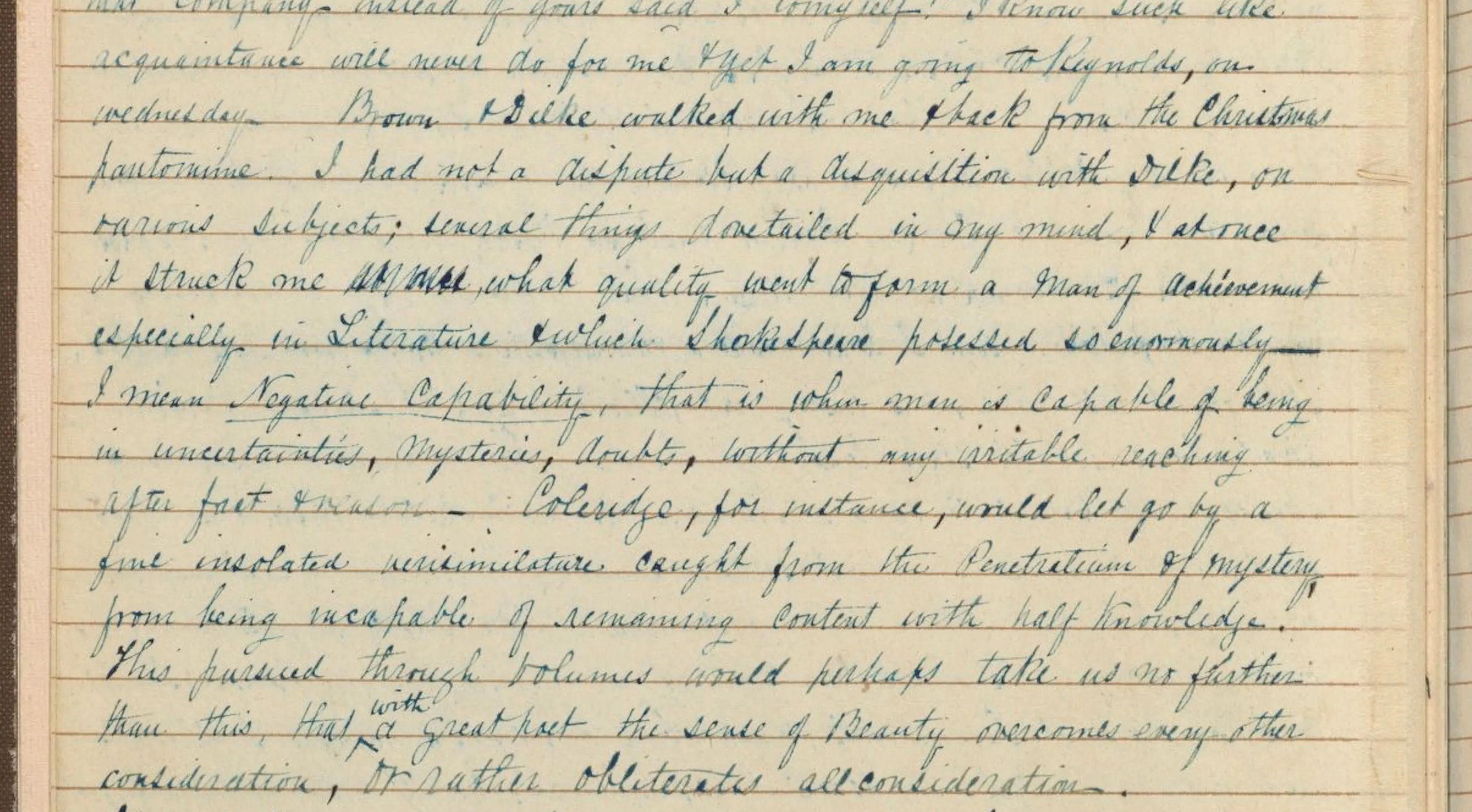
John Keats famously coined the phrase negative capability, which he defined as that quality “when a man is capable of being in uncertainties, mysteries, doubts, without any irritable reaching after fact and reason.” The yearning to attain artistic beauty, to decipher the numinous, will always be incongruous with existing logical frameworks—philosophical, mathematical, statistical—but the contradiction does not have to be resolved. You hold onto it, keep it with you. Negative capability also resembles another well-known assertion later made by F. Scott Fitzgerald in “The Crack-Up,” that
the test of a first-rate intelligence is the ability to hold two opposed ideas in the mind at the same time, and still retain the ability to function. One should, for example, be able to see that things are hopeless and yet be determined to make them otherwise. This philosophy fitted on to my early adult life, when I saw the improbable, the implausible, often the “impossible,” come true. Life was something you dominated if you were any good. Life yielded easily to intelligence and effort, or to what proportion could be mustered of both. […] Of course within the practice of your trade you were forever unsatisfied—but I, for one, would not have chosen any other.
I love the candid diction here: “still retain the ability to function.” The choice of words doesn’t denote an aesthetic principle, a poetic ideal like Keats; it’s more like—Can I still function in this world and not go crazy?
It’s a weird time, and I don’t have any playbook for coping with it. I’m just on autopilot and moving mechanically. I’m definitely worried about money; I’ve stopped dreaming about long-term plans; I’m thinking about stupid things like whether my quarantine beard has precursors of the gray to come or whether it’s actually an anomalous streak of auburn that inexplicably emerges sometimes.
Lockdown life is momentous and mundane all at once. It shocks and it dulls. “My heart aches, and a drowsy numbness pains / My sense, as though of hemlock I had drunk.” Pick your framework: try to resolve things within a harmonious system of axioms; be a poet and embrace the multitudes; just function and don’t go crazy. Overall, I just miss talking through it. Keats wrote letters and worked through his shit. In the correspondence where Keats wrote the words “Negative Capability,” Shakespeare was his exemplar of the attribute. An impossible bar, to be sure, but as Bryce Radick recently wrote:
The thing about “Shakespeare wrote King Lear during quarantine” is like
Ya??? Because that was his job?? I will also be doing my job during quarantine, and at this rate I *expect* tweets dedicated to my covid honor
So Ya, I’m trying to hold my uncertainties close, to feel the conflict and still remain functional. Smarter people have wrestled with how to conceive of it all, on a geologic time scale. Most pithily, as a key character says in my favorite film by the Coen brothers, A Serious Man (photographed by Mr. Roger Deakins), “Accept the mystery.”